
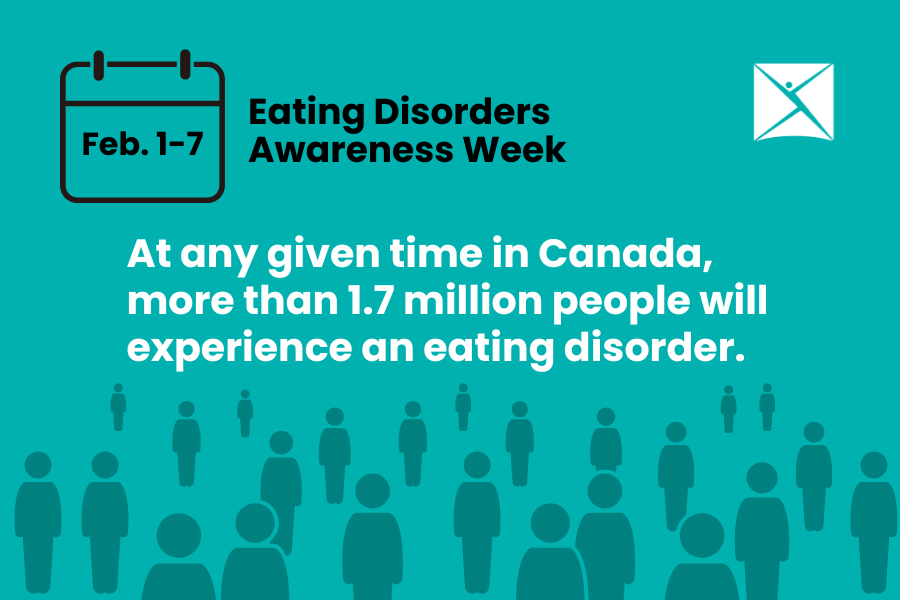
Eating disorders are serious but treatable mental illnesses. At any given time in Canada, more than 1.7 million people will experience an eating disorder.[1] An estimated 1.4 million youth in Canada are affected, yet only 25 per cent receive appropriate treatment.[2]
A national gap in access to care
Despite being prevalent and serious illnesses, eating disorders are undertreated. Research shows clear gaps in access to specialized care, particularly outside urban centres.
Studies in our neighbouring province, Ontario, found that places with fewer services, especially rural areas, have higher rates of eating disorders.[3] Distance matters: long travel times and limited local options can make accessing mental health care difficult or impossible, leading to delayed treatment and poorer outcomes.[4][5] This can be particularly difficult in rural areas where there are fewer services available.[6]
For many Canadians, care simply isn’t close enough—or accessible enough—to be realistic.
Kristin’s experience
Those gaps were all too real for Kristin, a Cartwright resident and NunatuKavut community member on the south coast of Labrador.
“When I finally decided I needed to get help, I went to my little local community clinic… I was immediately given a full check-up, referred for a bone density scan, and referred to our provincial eating disorder recovery program. All of that was amazing and happened so fast; I felt seen and taken seriously.”
But that initial support couldn’t overcome the realities of geography.
“I’ve always lived in a tiny, isolated community at the end of a long dirt road… I was able to connect with an addictions counsellor over the phone, but she was new to the job and mostly trained in substance use, with no real experience in eating disorders.”
Kristin was approved to be admitted to the provincial eating disorder program, but it was 1,400 kilometres away.
“I would have had to drive 400 kilometres to the nearest airport, then fly the rest of the way. I have three kids and a job. I couldn’t just leave for 8 to 12 weeks.”
Even though the program itself was free, the hidden costs made it impossible.
“I would have had to pay to fly there and back, rent a place in the city, keep paying my mortgage at home, and give up my income. My family would have been bankrupt before I got home.”
“That’s a really hard reality to talk about—but it’s a reality for many people. The help I needed was too far away, and I couldn’t afford the cost of accessing it. This is one of the biggest issues for people living in Indigenous communities: access to specialized care.”
Eating disorders have some of the highest mortality rates of any mental illness, and early access to appropriate care is critical for recovery. Yet, long wait times, limited provider training, and lack of services continue to disproportionately affect people outside major cities.
For Indigenous Peoples, especially those in remote or fly-in communities, ongoing healthcare workforce shortages mean clinics often rely on short-term providers who may lack specialized training—forcing people to travel long distances or go without care altogether.
What needs to change?
Awareness alone isn’t enough. Real change requires action. For Kristin, that action looks like:
- Equity in Access: Care must reach smaller, isolated communities and groups that have historically been left behind.
- Community-Based Support: First Nations, Inuit, and Métis communities need access to a continuum of trauma informed and culturally appropriate services in or near their communities.
- Training from Within: Investments are needed to support Indigenous workforce development and the delivery of culturally appropriate care.
- Investments that support health equity in the long term: All of the above will require sustained and predictable investments in local Indigenous-led programs and organizations to build their capacity to deliver care.
Every year, from February 1 to 7, Eating Disorders Awareness Week (EDAW) aims to raise awareness about eating disorders while challenging the stigma and barriers that limit access to care.
If you or someone you know is struggling with an eating disorder, please contact us or the National Initiative for Eating Disorders (NIED) for support.
Kristin is an Indigenous member of NunatuKavut Community Council. She lives in Cartwright, Labrador with her husband, three kids, and three huskies. She serves her small community as an Emergency Medical Responder of 12 years. She is passionate about eating disorder advocacy and is a proud member of the former Canadian Mental Health Association’s National Council of Persons with Lived Experience.
[1] Galmiche M, Déchelotte P, Lambert G, Tavolacci MP. Prevalence of eating disorders over the 2000–2018 period: a systematic literature review. The American Journal of Clinical Nutrition. 2019;109(5):1402–1413. doi: 10.1093/ajcn/nqy342.
[2] Government of Canada, Canadian Institutes of Health Research. “More than 1.4 Million Canadian Youth Have an Eating Disorder – but Better Data and Early Interventions Are Fighting Back.” CIHR, 8 Sept. 2025, cihr-irsc.gc.ca/e/54456.html.
[3] Pang, Nelson, et al. (2024). “Mapping Eating Disorders in Adolescents and Young Adults: An Investigation of Geographic Distribution and Access to Care in Ontario, Canada.” Journal of Eating Disorders, U.S. National Library of Medicine, pmc.ncbi.nlm.nih.gov/articles/PMC11385241/.
[4] HL;, Holley. (1998). “Geography and Mental Health: A Review.” Social Psychiatry and Psychiatric Epidemiology, U.S. National Library of Medicine, pubmed.ncbi.nlm.nih.gov/9803821/.
[5] G;, Kelly C;Hulme C;Farragher T;Clarke. (2016). “Are Differences in Travel Time or Distance to Healthcare for Adults in Global North Countries Associated with an Impact on Health Outcomes? A Systematic Review.” BMJ Open, U.S. National Library of Medicine, pubmed.ncbi.nlm.nih.gov/27884848/.
[6] JP;, Sibley LM;Weiner. (2011). “An Evaluation of Access to Health Care Services along the Rural-Urban Continuum in Canada.” BMC Health Services Research, U.S. National Library of Medicine, pubmed.ncbi.nlm.nih.gov/21281470/.